Pros and Cons of Living in Bermuda: Is It Worth It?
A job in Bermuda can be the best move of your career or a quietly miserable two years away from home. The deciding factor is rarely the salary or the beaches. It is whether the trade-offs that come with island life fit the kind of person you actually are.
This page sets out both sides plainly, drawn from years of conversations with expats who came, stayed, and in some cases left early.
The Pros
Tax-free Take-home
Bermuda has no personal income tax and no capital gains tax. What you take home is largely yours. There is a payroll tax that your employer pays, and they may pass a portion of it through to you on your payslip (the employee portion is calculated across bands).
The cap on the employee portion sits at the first $1 million of remuneration per person per year, so even the very top of the market is shielded from runaway tax. For most expats this is the single biggest financial reason to be in Bermuda.
The math gets more interesting if you can structure your savings sensibly while you are here, since you are accumulating wealth in a tax-free environment that you can later carry home, subject to the rules of your home country.
A Lifestyle You Cannot Match on the Mainland
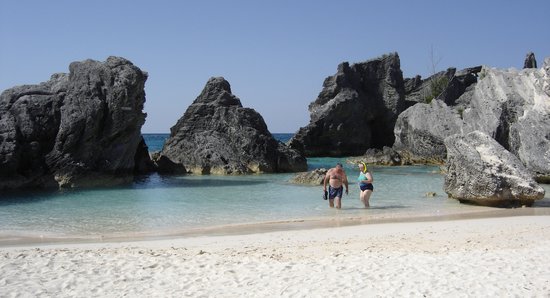
Bermuda has pink-sand beaches, clear water and an outdoor culture that survives most of the year. The island is small enough that you can be at the beach in twenty minutes from anywhere. Sailing, snorkeling, paddleboarding, kayaking, golf (more golf courses per square mile than almost anywhere) and tennis are the everyday backdrop.
Hamilton is walkable. Crime is low. The streets feel safe at night in a way many cities no longer do. For families with young kids and for working adults who want to swim before breakfast, this is hard to argue with. The weather helps. Summers are warm with steady Atlantic breezes, and winters rarely drop much below the mid-50s in Fahrenheit.
A Friendly Community
Bermudians, in my experience, are some of the warmest and most courteous people you will meet. There is a habit of greeting strangers on the bus. There is a real expat community across nationalities and sectors. You will be invited to things. You will know your neighbors.
Most expats I have heard from describe the social side as one of the things they did not expect to value as much as they ended up doing. The flip side is that anonymity is in short supply. The island talks. If you want to disappear into a crowd, this is not the place.
Career Capital
Bermuda is the global capital of reinsurance and a serious financial center. Two or three years on a Bermuda CV in the right role can move your career several rungs forward.
Senior leaders in insurance, asset management, captive management, fund services and law often cycle through Bermuda. The professional network you build here travels with you wherever you go next.
Many former Bermuda expats end up in London, New York, Zurich, Singapore or Dublin in roles that pay better than they would have at home, partly because their Bermuda chapter sharpened their commercial edge.
Safety and Stability
Bermuda is politically stable, has a sound legal system rooted in English common law, and holds the highest credit ratings among small jurisdictions. Public services work. Power is reliable. Roads are maintained.
The hospital can handle most acute care, and serious cases are routed to Boston or other US centers under arrangements that most employers' insurance plans cover.
As a place to raise young children safely, walk home from dinner without thinking about it, or leave your bicycle outside the cafe while you grab a coffee, Bermuda still feels like the world thirty years ago.
The Cons
You Stay on a Permit
A work permit gives you the right to live and work in Bermuda for a specific employer for a specific period. It is not a path to permanent residence and it is not citizenship. Under the Work Permit Policy effective 1 November 2025, you cannot change roles within the first year of a new permit or within six months of a renewal.
You cannot change employers in the first two years (accountants get an exception after 18 months). The maximum term limit on permits was removed in 2013, so you can in principle keep renewing, but each renewal is fresh and depends on no eligible Bermudian being available.
Plan your finances and your exit on the assumption that one day the renewal will not come. Penalties of up to $10,000 apply for unauthorized work, and the policy can put a non-compliant worker on the Bermuda Stop List, barring re-entry as a worker for a minimum of 12 months.
Permanent Residence and Citizenship Are Hard
There are pathways but they are narrow. A Permanent Resident Certificate (PRC) is available after 20 years of ordinary residence under the standard rule, 15 years for non-Bermudian parents of children with Bermudian status, or 10 years for Job Maker-exempted residents and their immediate family.
PRC lets you live and work without a permit, and it lets you buy a home with a lower Annual Rental Value threshold, but it is not citizenship. Bermudian status, the closest thing to citizenship for an expat, is mostly available only through long marriage to a Bermudian.
The system is designed to protect a small population of around 63,800, and it does its job. If you are coming hoping to settle for life, recalibrate that expectation now.
One of the Highest Costs of Living in the World
Almost everything on the island is imported. Numbeo's cost-of-living index regularly ranks Bermuda at or near the top of its global table, well above New York and most major European capitals. Groceries cost roughly 40 to 50 percent more than in a US city.
Restaurants are pricier still. Utility bills run higher because electricity is generated locally on imported fuel. Fuel, services, household goods, all higher than what you are probably used to. A six-figure salary in Bermuda does not stretch the way it would in most US or European cities. Walk through
Bermuda's Cost of Living for line-by-line numbers before you commit.
Rental Housing is Expensive
You will rent. Houses cannot be purchased by non-Bermudians except in narrow categories of designated high-end properties, and those are typically held in millions. Even with a housing allowance, rents in central areas can run $2,500 to $8,000 a month and up depending on size, location and view.
A small one-bedroom apartment in or near Hamilton commonly sits at $2,500 to $3,500. A family-size three-bedroom can be $6,000 to $10,000, and waterfront homes climb sharply from there. Negotiating a housing component into your offer is not a courtesy, it is a requirement.
One Job Only, and No Side Hustles for a While
A non-Bermudian holds a permit for one employer in one role. Bermudians often work multiple jobs (one daytime, another in the evening) to cover their bills. You cannot do the same in the first two years. After that, picking up a second job is theoretically possible but practically difficult because the local-first preference applies again.
Casual freelance work for foreign clients is generally tolerated where it does not displace a Bermudian, but always confirm with Immigration if you are unsure.
Health Insurance Is Mandatory and Costly
You must have local health insurance to access medical care on the island. Premiums are steep and a good employer covers most of the cost for you and your dependents. A typical family health plan can cost several hundred dollars per person per month, and dental and vision are usually separate.
Confirm exactly what is covered, what your share is, and what overseas care looks like. The hospital is competent for most cases, but for major procedures patients are often referred to Boston, Baltimore or Philadelphia.
Schools Cost Real Money
Private schools in Bermuda offer a strong education that maps onto US, UK or Canadian university tracks. They also charge for it. Top private schools run upward of $25,000 per child per year, and scholarship support is generally reserved for Bermudian students.
Public schools are available but most expat families end up in the private system because the international curriculum and university pipeline matter to them. If you have two or three school-age children, school fees alone can run $50,000 to $75,000 a year, before uniforms, trips and extras. See
Schooling in Bermuda.
You Are on an Island
Bermuda is 21 square miles. There is no mall the size you remember from home. There is no movie multiplex. The major fast-food chains are largely absent (one KFC, plus local outlets). Nightlife exists but it is small. International flights are limited to a handful of US East Coast cities, plus London and Toronto.
Trips to see family or to do "real" city shopping become weekend logistics rather than spur-of-the-moment plans. If you need a big city's variety, two or three years on Bermuda will start to feel small.
The flip side is that you are not stuck in traffic for two hours a day either, and many expats use the saved commute time to add hours of family or beach time to every week.
Visitors Can Only Stay so Long
Friends and relatives can visit you only as tourists, and tourists can stay a maximum of six months in a rolling period of 12 months. Only your spouse and your dependent children are allowed to stay with you for as long as you hold the permit.
For expats with aging parents back home, this is one of the harder parts of the deal. You will fly back to see them rather than the other way around.
One Car per Household
The Motor Car Act of 1951 limits each Bermuda household to one private four-wheeled vehicle. Only a Bermuda-issued driving license is valid for residents. Many people get around on small mopeds or scooters, and the bus and ferry services are good.
If you grew up with two or three cars in the driveway, this takes adjustment. The upside is fewer traffic jams, lower carbon impact and a habit of walking and ferry-riding that most expats grow to like.
Hurricanes Are Part of the Climate
Bermuda sits in the Atlantic hurricane belt. The official season runs from June to November. Direct hits are not frequent but they happen, and the island is well prepared. Buildings are constructed to weather standards that handle most storms.
Employers and the government issue clear guidance ahead of severe weather. If you have never lived through a hurricane, the first one is unnerving. After that, it becomes part of the seasonal rhythm.
The Remote Work Door Has Closed
The Work from Bermuda one-year residential certificate that ran from 2020 was discontinued on 28 February 2025. About 1,800 people used the program during its run. If you were hoping to come purely as a remote worker for a foreign employer, that program is no longer accepting applications.
Other residency options exist (Permission to Reside on an Annual Basis, the Economic Investment Certificate for those willing to put $2.5 million into qualifying Bermuda assets) but they carry their own thresholds and they do not include local employment.
Who Thrives in Bermuda?
The expats who do well here usually have several of the following.
They earn enough that the cost of living does not dominate their daily decisions.
They are at a stage of life (mid-career, no school-age children, or with employer-funded education) where the inconveniences are manageable.
They enjoy outdoor and ocean activities.
They are extroverted enough to plug into a tight community quickly.
They came for a defined chapter, a job, a milestone career move, a savings goal, rather than expecting to stay forever.
They have a partner or family on board with the trade-offs.
They treat the island with respect, learn local customs and history, and behave like grateful guests rather than entitled customers.
Who Struggles in Bermuda?
The people who struggle tend to be those on lower salaries who hoped the tax saving would offset the cost of living and find that it does not. Those who expected city amenities or anonymity.
Those who came alone and never built a local circle. Those whose spouse could not find work and grew restless. Those with elderly parents back home and serious distance anxiety.
And those who treated "tax haven" as code for "easy life" and were surprised by the discipline the system actually demands.
What to sort out before you say YES
Run the numbers honestly with your specific package. Add up gross salary, housing allowance, education benefit and health coverage, then subtract a realistic budget for rent (if not covered fully), groceries, utilities, transport, school extras, dining and travel home.
Compare what is left to what you can save now at home. If the gap is small or negative, the offer is not as good as it looks.
Plan your home-country tax exposure. Some passports tax you on worldwide income regardless of where you live. Others stop taxing once you establish residency abroad. Speak to a cross-border accountant before you sign.
Talk to your partner and your children honestly. Bermuda works best when everyone in the household is enthusiastic about it. The expat marriages that crack here usually crack because one partner was reluctant from the start.
Plan an exit even as you plan an arrival. Most expats leave Bermuda eventually. The smart ones know what their next stop looks like.
Is Bermuda a Good Place to Live?
For the right person at the right point in their career, yes. The lifestyle is genuinely rare. The savings, if you are in a high-paying sector and you negotiate well, can be life-changing. The friendships, in my experience and in the experience of expats I have known for years, are real and often last decades after people leave.
For the wrong person, or for someone unprepared, Bermuda is a small, expensive, regulated island where the rules apply to you and not to your local neighbor. That is not a flaw in Bermuda. It is the deal you accept by coming.
If you treat your Bermuda years as a chapter, take the lifestyle seriously, save aggressively, and respect that you are a guest in a small country, you will likely look back on this time as some of the best years you ever had.
About the Author
 By Raj Bhattacharya
Raj has been writing about Bermuda since 2008, when he launched bermuda-attractions.com, one of the longest-standing independent guides to the island. A Certified Bermuda Specialist (Bermuda Tourism Authority), his work draws on personal visits, local contacts in Bermuda, and questions and trip reports from thousands of readers over the years.
Related Articles
|
Visitors' Reviews and Comments
Hana (September 2020)
Hi Raj, Thank you for the previous information. Just another quick question... As I am coming from the UK, I was planning on bringing my laptop and doing some work out in Bermuda (NOT for a Bermudian company or seeking work in Bermuda) just for helping my work out back in the UK.
Would you know if there are any contacts that I could ask if this would be OK? It would just be 'remotely working' from the apartment (my partners) I am staying in for the UK company I am already employed for? Or if you could help that would be really helpful. If you need any more information, please do let me know. Thanks,
Raj (bermuda-attractions.com) September 2020
Hi, Personally I don't think working remotely on your laptop while visiting Bermuda would be a concern, otherwise sending out an official email to one's company back home could also be deemed as working out remotely... many visitors I am sure, need to do so. I don't think any country has any law against this. Bloggers do this all the time.
Bermuda is actually going a step ahead and even offering a one-year residence for such remote work. However, if you need to use an app or connect to an online system that are restricted or banned in Bermuda, you will obviously not be able to work remotely. For official guidelines and clarifications on the matter, I suggest you contact Bermuda's Department of Immigration (Phone: +1 441 295 5151, Ext. 1378). Best,
Jay (April 2017)
Hi, If I moved to Bermuda with my spouse, who will have a work permit, and I worked from home for my current employer (international company) would I need to obtain a work permit? Would this be allowed or would it need to be Bermudian company I work for, to live and work on Bermuda?
Raj (bermuda-attractions.com) April 2017
On a spouse visa you are not allowed to work in Bermuda, for that you need a work permit of your own. However there is no guidelines restricting spouses to work for their international companies online from Bermuda, because that does not jeopardize jobs of Bermudians.
|